

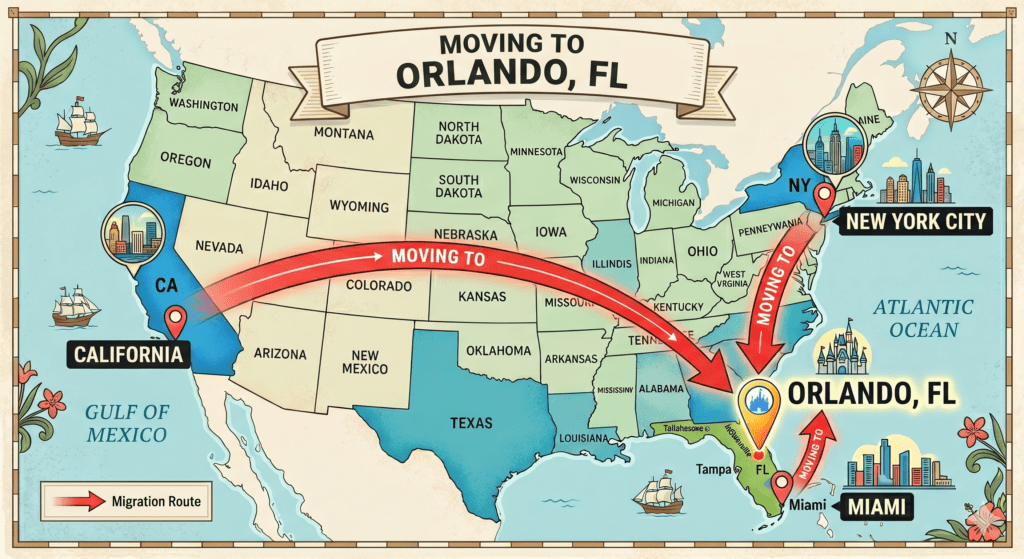
Every week my phone rings with some version of the same call. Someone in Miami, or New York, or California (sometimes all three cities in the same week) asking me the same question.
“Ray, we’re thinking about moving to Orlando. Where do we even start?”
I love that call. I’ve been taking it for over 20 years. And the honest answer is always the same: start with the facts, figure out what matters most to your family, and then let the neighborhood find you.
So that’s what this guide is. The facts: real 2026 numbers, real comparisons, real neighborhood breakdowns, organized by where you’re coming from. Because moving from Miami looks very different from moving from New York, which looks very different from moving from California. The math is different. The lifestyle adjustment is different. And the neighborhoods that tend to click for each group are different too.
Let’s walk through all of it!
Why Orlando? Here's what the data says in 2026
Orlando added nearly 76,000 new residents in 2024 and another 38,000 in 2025: roughly 1,500 people per week at its peak, making it one of the fastest-growing large metro areas in the country. That growth didn’t happen because of theme parks. It happened because of jobs, affordability relative to coastal markets, and a quality of life that’s genuinely hard to argue with once you’ve experienced it.
The metro area’s population now sits at nearly 3 million. The job market added 37,500 positions in 2024 across healthcare, tech, hospitality, and professional services. Walt Disney World, AdventHealth, and Universal Orlando anchor the employment base, but Siemens Energy is relocating its North American headquarters to Lake Nona and bringing close to 3,000 jobs with it by 2027. This is not a one-industry city anymore.
And the housing market in 2026, while no longer the frenzy it was in 2021, is still very much a market where buyers can find real value. The metro median home price sits around $410,000. Active listings have jumped significantly year over year. And sellers are negotiating in ways they simply weren’t two years ago.
People sometimes assume Orlando is just a tourist town. And I understand why, the theme parks are massive and they’re everywhere. But the people who actually live here know it’s a real city. Real neighborhoods, real restaurants, real schools, real careers. It just also happens to have Disney 45 minutes away, which most of us treat as a Tuesday night activity rather than a vacation.
If You're Moving to Orlando from Miami
Miami to Orlando is the single most common relocation route within Florida right now. And the numbers explain why pretty clearly.
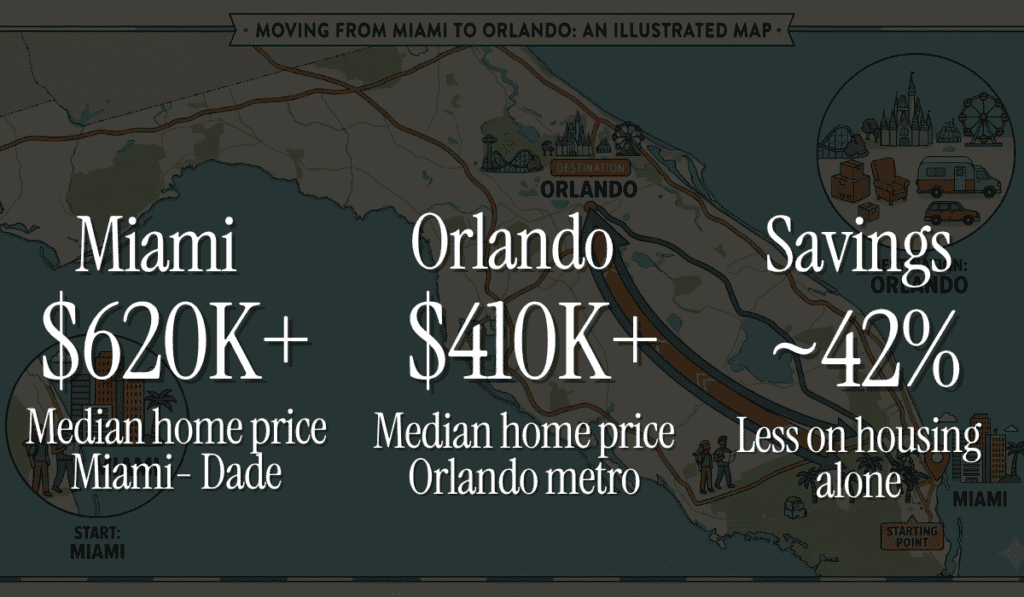
Beyond housing, Orlando’s overall lifestyle costs about 12% less than Miami-Dade County across groceries, transportation, dining, and utilities. You would need around $8,400 in Miami to maintain the same standard of life that $6,400 gets you in Orlando, that’s a meaningful gap when you’re talking about a monthly budget.
The Brightline high-speed rail connection has also made the move feel a little less permanent for people who have family or ties in South Florida. Miami to Orlando is about three hours by train, which has made the decision easier for a lot of the buyers we’ve worked with.
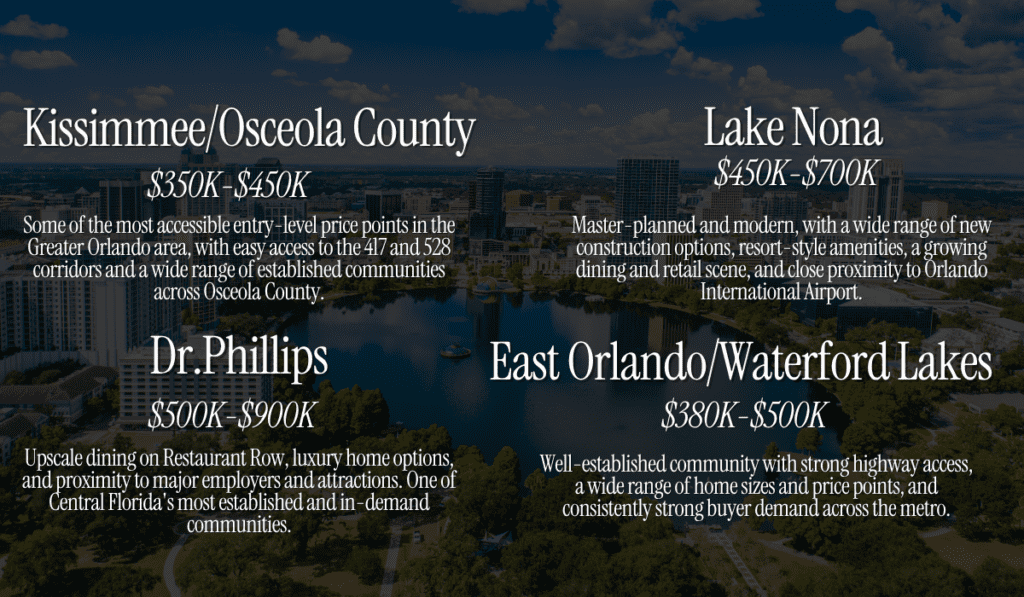
Orlando Communities to Explore from Miami
If You're Moving to Orlando from New York
New York is consistently one of the top states sending residents to Central Florida, and the financial case is about as clear-cut as it gets.
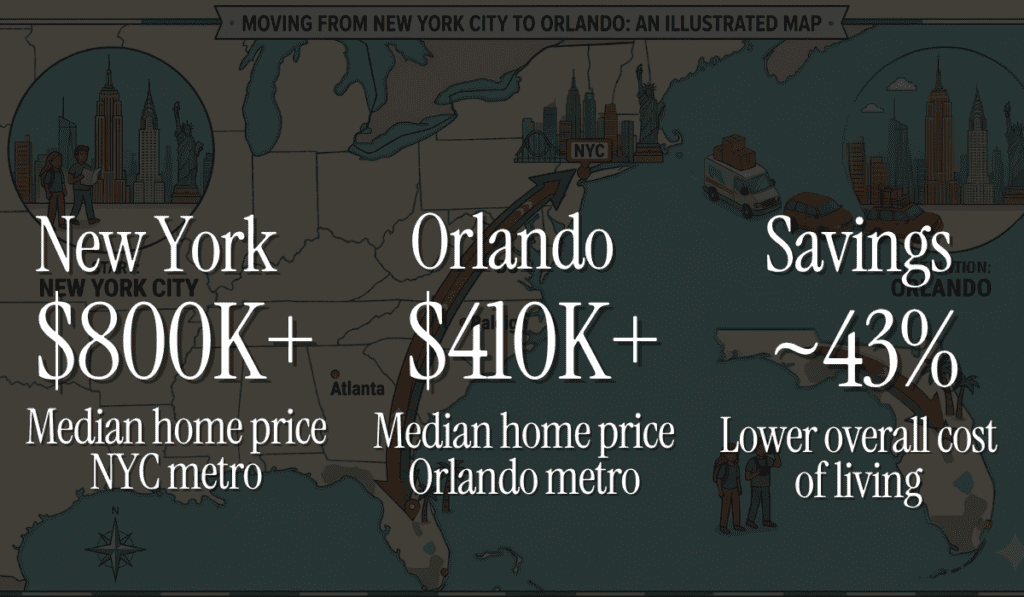
The tax savings alone stop a lot of New Yorkers in their tracks. Florida has no state income tax. A New York City household earning $200,000 saves approximately $53,578 per year by relocating to Orlando across housing, taxes, childcare, dining, and daily expenses.
The lifestyle adjustment from New York is real, Orlando is car-dependent, the pace is slower, and the city operates differently. But the community in Central Florida is large enough that most people find their footing quickly.
The thing people say most consistently after they’ve been here six months? They can’t believe they waited so long. The space. The quiet. The fact that their $600,000 got them a four-bedroom home with a pool and a two-car garage. It takes a little adjusting, but nobody’s gone back.
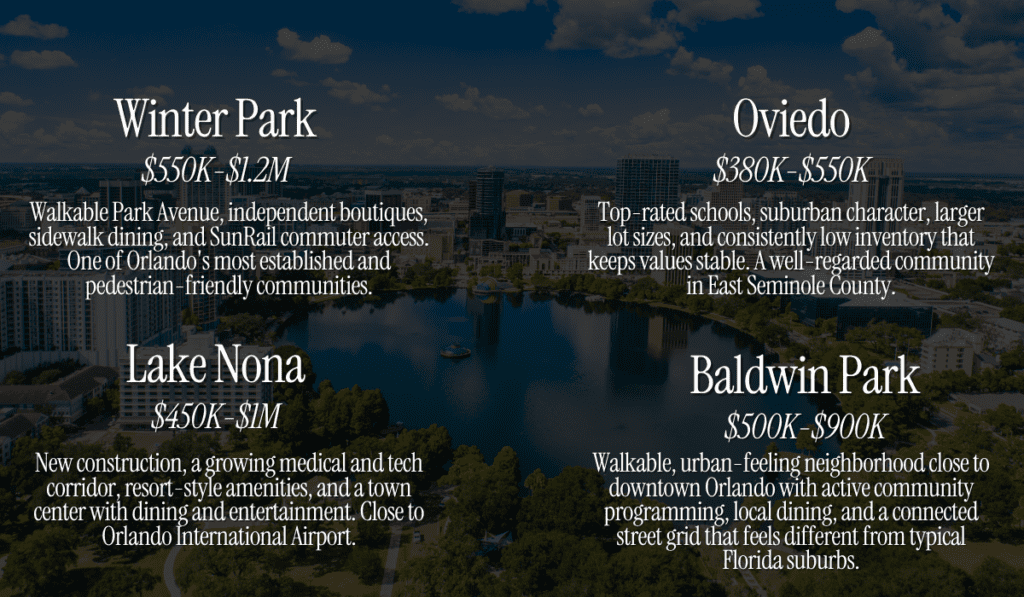
Orlando Communities to Explore from New York
If you're Moving to Orlando from California
California has been the U.S.’s largest source of domestic outmigration for six consecutive years, and a meaningful portion of those residents have found their way to Central Florida.
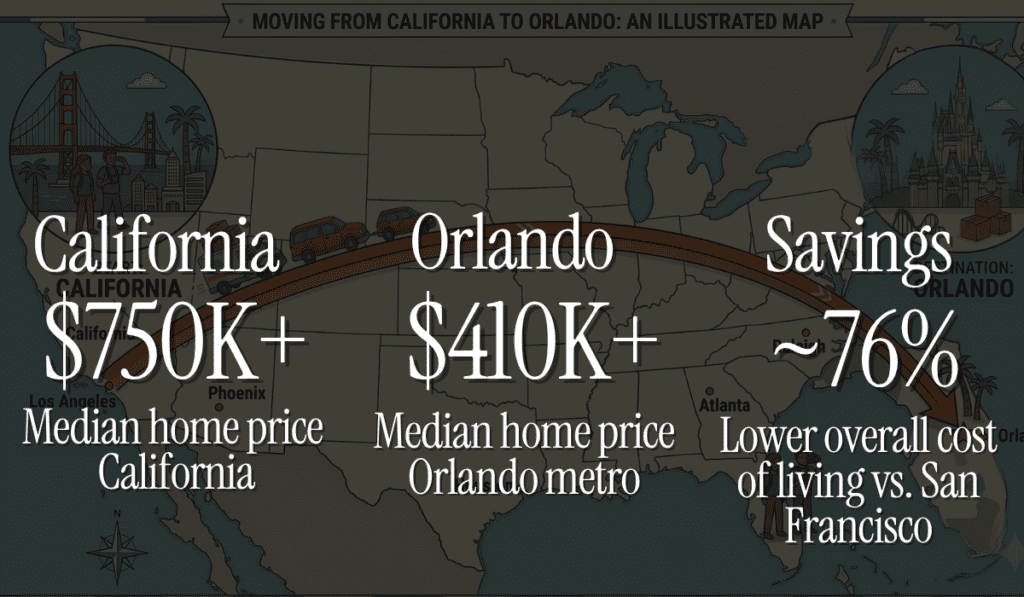
A budget that buys a two-bedroom condo in a mid-tier LA neighborhood can buy a four-bedroom home with a pool in many Orlando communities. For high earners, the lack of state income tax represents the single largest ongoing financial benefit, a $150,000 salary keeps roughly $8,000–$12,000 more annually compared to California.
The year-round warmth, the water access, the golf, the trails, California buyers tend to appreciate Orlando’s outdoor lifestyle quickly. And for remote workers who need to stay connected to West Coast teams, the Eastern time zone actually works well, you’re ahead of your colleagues, which most people find easier than being behind.
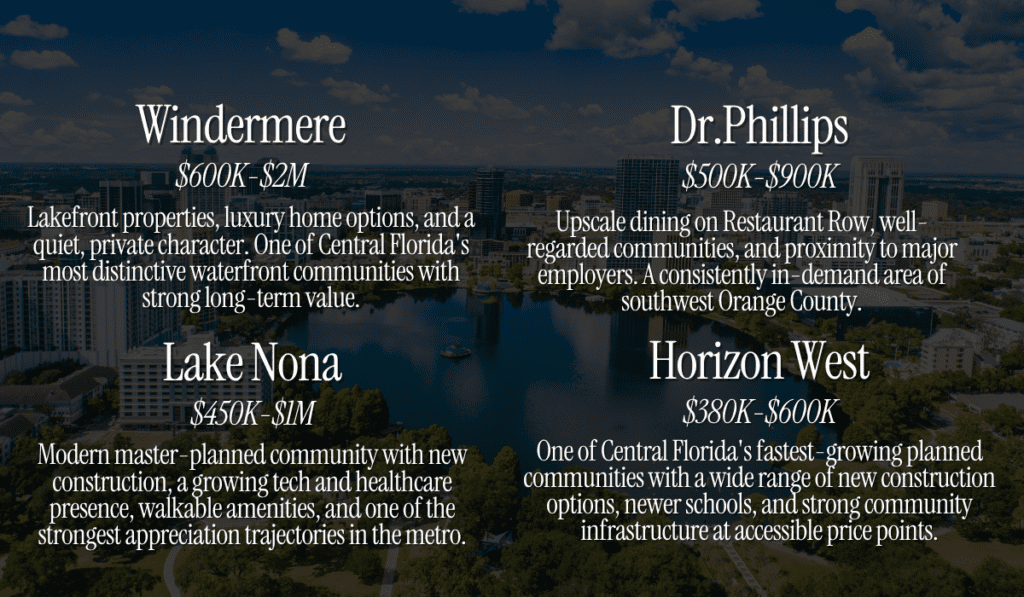
Orlando Communities to Explore From California
What Everyone Asks: Honest Answers
Whether you’re coming from Miami, New York, or California, the questions I get are remarkably consistent. Here are the ones that come up most:
- Schools — Orange County Public Schools is one of the largest districts in Florida. Seminole County, which borders Orange to the north, consistently ranks among the top school districts in the state. The experience varies significantly by area, so it’s worth talking through your specific priorities before you start your search
- Traffic — If your daily commute crosses I-4 during rush hour, plan for it. Most of the communities we’re talking about have good access to the 408, 417, and 528 without requiring I-4 dependence
- Affordability — Yes, it really is that much more affordable relative to where most of our relocation buyers are coming from. The numbers are not exaggerated
- Community — Orlando’s population is large. Most relocation buyers are surprised by how quickly they find people who made the same move and are happy to share what they’ve learned
- The heat — It’s real, especially July through September. Most people adapt within a year and then wonder how they ever lived somewhere cold
Practical Things To Know Before You Move
- Florida has no state income tax – one of the most significant ongoing financial benefits, especially from high-tax states like New York, California, and New Jersey
- Orange County property taxes average approximately 0.97% of assessed value – a $400,000 home generates roughly $3,900 annually, reduced further by Florida’s homestead exemption of up to $50,000 for primary residents
- You have 30 days after establishing Florida residency to get a Florida driver’s license – the process takes about 45 minutes at the tax collector’s office and can be scheduled online
- Homeowners insurance in Florida has been rising – factor this into your budget and ask about flood zone designations for any specific property you’re considering
- The Brightline high-speed train connects Miami to Orlando in about three hours — a meaningful consideration for anyone relocating from South Florida with ties there
- Most Orlando communities are car-dependent — if walkability is a priority, focus your search on Winter Park, Baldwin Park, Avalon Park, or the Dr. Phillips area near Restaurant Row
The people I’ve seen struggle with the move are the ones who try to recreate exactly where they came from. Orlando is its own place with its own rhythm. The ones who do really well are the ones who come in curious and open to discovering what this city actually is rather than measuring it against what they left. And almost without exception, they’re glad they came.