
Every week, I get some version of the same question.
“Ray, what’s it really like living in Orlando?”
Honestly, I love that question because Orlando isn’t just theme parks and palm trees. It’s a real city with real neighborhoods, real traffic, real weather, and a rhythm all its own.
After helping thousands of families relocate to Central Florida over the last 20+ years, I’ve noticed a pattern. The people who adjust the quickest aren’t always the ones who did the most research. They’re the ones who came with realistic expectations.
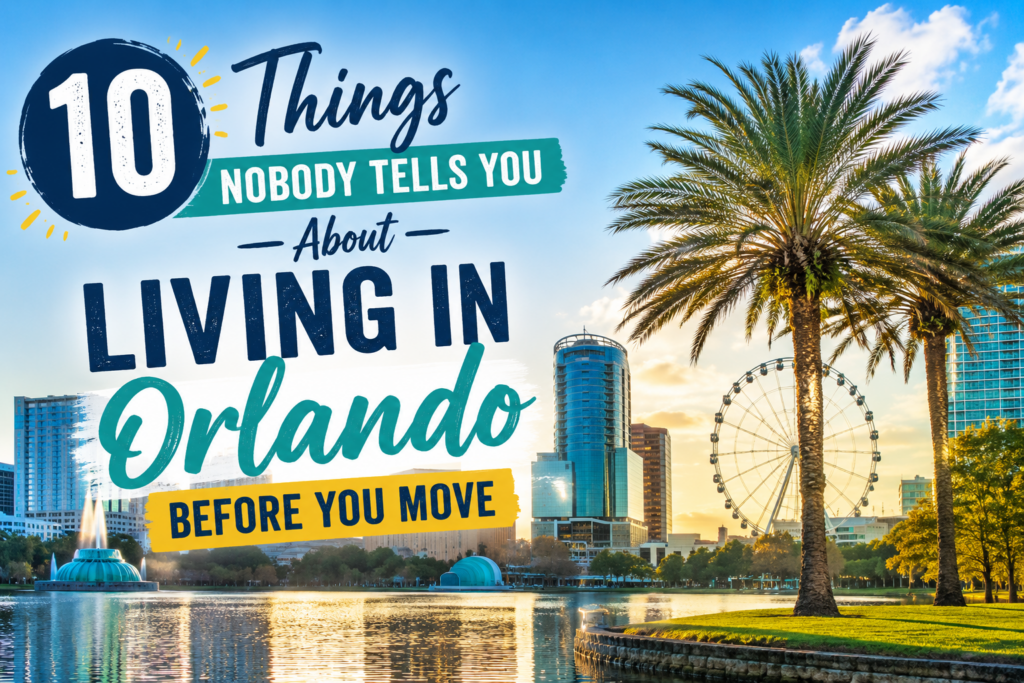
So here are 20 things nobody tells you about living in Orlando, but probably should!
1. The Summers Are No Joke
Everyone knows Florida is hot.
What they don’t realize is that Orlando summers feel like walking into a warm hug from someone who doesn’t understand personal space.
The combination of heat and humidity is real, especially if you’re moving from the Northeast, Midwest, or West Coast. We’re talking heat indexes that regularly push past 100°F from June through September, with humidity levels that make the air feel thick before you even make it to your car.
You learn to respect it quickly!
2. But You Adapt Faster Than You Think
Here’s the flip side.
Most people adjust to the heat faster than they expect. After a summer or two, you naturally shift your habits:
- Schedule outdoor activities for early morning
- Appreciate a good pool more than you ever have
- Never underestimate the power of a strong air conditioner
- And from October through April, step outside and wonder why everyone else still lives somewhere cold
That nine-month stretch of perfect weather is very real, and it’s a big reason most people who move here don’t leave.
3. Orlando Is Much Bigger Than People Realize
People often picture Orlando as one city wrapped around Disney.
It’s not even close.
Greater Orlando stretches across multiple counties and dozens of distinct communities. The metro area covers over 4,000 square miles. It’s one of the fastest-growing regions in the entire country, and it doesn’t feel like one place, it feels like a collection of towns that happen to be neighbors.
4. Every Neighborhood Has Its Own Personality
This is one of the first things we talk about with relocation buyers.
Waterford Lakes has a tight-knit, established feel, neighbors who’ve known each other for years, kids who grew up together, a community that actually shows up for each other.
Oviedo carries that small-town charm with strong local pride and some of the best-rated schools in the region.
Lake Nona is newer and more planned, drawing healthcare professionals and families who want walkability and modern infrastructure.
Avalon Park has a real Main Street energy: festivals, front porches, the whole thing.
Winter Park is historic, walkable, and has some of the best dining and boutique shopping in all of Central Florida.
The question isn’t really “is Orlando the right fit?” The question is “which part of Orlando is the right fit?”
One conversation usually points us in the right direction.
5. Traffic Depends More on Where You Live Than Orlando Itself
Can Orlando traffic be frustrating?
Absolutely.
I-4 has a reputation, and it’s earned. But here’s the part nobody tells you: a lot of that frustration is avoidable depending on where you choose to live.
A fifteen-minute commute can stretch to forty-five minutes if parts of I-4 are involved. But residents in Oviedo, Waterford Lakes, Winter Garden, and other suburban communities often navigate their entire day without touching it. The 408 and 417 toll roads have become lifelines for a lot of locals.
Choosing the right area for your work, school, and daily routine often matters just as much as choosing the house itself.
6. Alligators Are a Real Part of Florida Life
This one makes people nervous until they actually live here.
Yes, alligators exist in Florida. Yes, you will probably see one eventually: in a retention pond, near a lake, occasionally crossing a road. They are a genuine part of the natural environment here, and that’s not something to dismiss.
But here’s what longtime residents know:
Alligators are almost universally more interested in avoiding you than engaging with you. They’re not lurking in your backyard waiting for an opportunity. They’re doing what they’ve always done, living near water, sunning on banks, and minding their business.
The rules locals follow are simple and become second nature fast:
- Never feed an alligator, it’s illegal in Florida and genuinely dangerous
- Keep dogs and small children away from the edges of lakes, ponds, and retention areas
- Pay attention near any body of fresh water, especially at dawn and dusk
- If you see a large or aggressive gator near a populated area, call Florida Fish and Wildlife, don’t approach it
Most Floridians go years without an encounter. The ones who have issues are almost always the ones who got too close or didn’t respect the boundary.
It sounds alarming from the outside. From the inside, it’s just part of knowing your environment, the same way someone in the mountains learns to respect wildlife there.
Florida’s natural world is genuinely extraordinary. Alligators are part of it.
7. Orlando Has an Incredible Food Scene
Orlando’s dining scene has genuinely exploded over the past decade. Chef-driven concepts, international cuisine, neighborhood spots that become weekly rituals, food halls, rooftop bars, and hidden gems tucked into strip malls that somehow outperform restaurants in cities twice the size.
Some of the best conversations we have with new clients start with: “Okay, but where should we eat?”
We always have an answer!
8. The Afternoon Thunderstorms Become Part of Your Routine
Summer thunderstorms in Orlando are basically a daily weather reset.
Sunny skies. Thirty minutes of rain. Back to sunshine.
When you first move here, you might find yourself canceling plans at the first sign of clouds. After a few months, you check the radar, shrug, and grab an umbrella.
It becomes part of the rhythm. And on the right afternoon, watching a storm roll across a Florida sky from your back porch is genuinely one of the most beautiful things about living here.
9. Hurricane Season Is More About Preparation Than Panic
This is one of the biggest misconceptions about Florida living.
Yes, hurricane season is real. Yes, Floridians take it seriously. No, it doesn’t mean everyone is constantly boarding up windows and waiting for disaster.
Most longtime residents simply build preparedness into their routine: emergency supplies, a few days of bottled water, phone chargers, flashlights, and a basic plan. It becomes second nature, the same way people in the Midwest know what to do when tornado warnings go up.
Orlando’s inland location also provides meaningful distance from the direct coastal impacts. Storms do bring heavy rain and wind, and low-lying areas can see flooding, so understanding your specific area’s risk matters. But for most residents, peak hurricane season (August through October) just means paying closer attention to the forecast.
10. Orlando Is Way More Than a Tourism Economy
This one surprises almost everyone.
Yes, tourism is a massive part of Orlando’s identity. But people who assume the whole economy runs on theme park tickets are missing a much bigger picture.
Healthcare, technology, higher education, logistics, defense contracting, professional services, sports and recreation, all of it has roots here and continues to grow. The University of Central Florida is one of the largest universities in the country and drives a significant research and innovation ecosystem. Lake Nona’s Medical City is redefining what a healthcare hub looks like. The simulation and modeling industry has deep ties to the military and aerospace sectors.
Orlando’s economy is a lot more diversified than its reputation suggests.
11. The Job Market Here Is Quietly Booming
Related to the above, but worth its own mention!
AdventHealth and Orlando Health are two of the largest employers in the state. The tech sector has been growing steadily. Finance, logistics, and distribution companies have been relocating here for years. And the entrepreneurial culture in Central Florida is real, a lot of people move here and end up building something of their own.
If you’re relocating for a career or planning to job search after your move, Orlando is in a much stronger position than many people expect.
12. The Cost of Living Might Surprise You (In a Good Way)
No state income tax is the one most people know going in.
But the broader cost of living picture is worth understanding. Compared to Atlanta, Nashville, Austin, or virtually any major Northeast or West Coast metro, Orlando offers significantly more home for your dollar. Established neighborhoods, a wide range of community types, and real value at price points that would be out of reach in most of the markets people are relocating from.
That gap has narrowed some over the past few years as more people have discovered what Central Florida offers. But relative value is still one of Orlando’s strongest cards.
13. Homeownership Costs Look Different in Florida
This one catches relocation buyers off guard more than almost anything else.
Most people focus on the home price. The bigger conversation needs to include:
- Homeowners insurance
- Property taxes
- Utilities, and yes, air conditioning runs longer here
- HOA fees if applicable
- Ongoing maintenance
Understanding the full monthly picture before you fall in love with a house saves a lot of stress later. A good agent walks you through all of this before you make an offer, not after.
14. HOAs Are Part of Life in Most Neighborhoods
A significant portion of Orlando’s established and newer communities are governed by homeowners associations.
HOAs vary enormously. Some are barely noticeable. Others have detailed rules about landscaping, exterior paint colors, parking, and pets. The fees range from minimal to substantial, and the financial health of the association matters just as much as the rules themselves.
This isn’t inherently a bad thing, well-run HOAs help protect property values and keep neighborhoods looking their best. But reviewing HOA documents before you close is a non-negotiable step, and it’s one that first-time buyers in this market sometimes underestimate.
15. Getting Around Orlando Is Easier Than People Think
Yes, a car is still the most common way people get around, and depending on where you live, it’s probably part of your daily routine. But Orlando’s transportation options are more developed than most newcomers expect.
SunRail connects communities from DeBary in the north down through Poinciana in the south, with stops through downtown Orlando, Sand Lake Road, and beyond, and it’s still expanding. Amtrak runs through the area with service to major Florida cities. The Lynx bus network covers a wide footprint across Orange, Seminole, and Osceola counties. And the SunRail to Orlando International Airport connection has made the region more connected than it’s ever been.
Walkability varies by community. Some neighborhoods – Winter Park, Thornton Park, College Park, Baldwin Park, and parts of downtown Orlando – are genuinely walkable in the way people from northern cities are used to. Others are more car-dependent by design, which is worth factoring into your neighborhood search if walkability matters to you.
Orlando isn’t New York, but it’s also not the car-only sprawl people assume. If getting around without a car most of the time is a priority, there are communities here where that’s a very realistic lifestyle.
16. The Natural Beauty Here Is Underrated
People think Florida and picture flat, developed land.
They’re not wrong that it’s flat. But the natural environment around Orlando is genuinely beautiful in its own way, and wildly underappreciated.
Wekiwa Springs State Park, Blue Spring State Park, Lake Jesup, the chain of lakes running through the area, it’s all right here. Kayaking, paddleboarding, hiking, birdwatching, fishing, Florida’s outdoor life isn’t in spite of the development. It’s running alongside it, if you know where to look.
17. The Local Culture Runs Deep
Orlando has a genuine local identity that has nothing to do with theme parks.
The craft brewery scene, the farmers markets, the arts community centered around Thornton Park and Mills 50, the sports culture around the Orlando City Soccer Club and the Magic, the festivals, and the local radio stations that actually play local music.
The longer you live here, the more layers you find. And the locals who love this city tend to love it fiercely, in that quiet, “you have to live here to understand it” kind of way.
18. The Communities That Fit You Best Aren't Always the Ones You've Heard Of
Most people moving to Orlando have a short list of neighborhoods they’ve seen in articles or YouTube videos.
That’s a fine starting point. But some of the best fits we’ve found for families come from communities they hadn’t considered at first, or hadn’t even heard of.
The conversation that helps most is the one about lifestyle. Not just bedrooms and square footage, but how you want your daily life to feel. That conversation opens up options that a Google search alone won’t surface.
19. The People Who Move Here Tend To Stay
I’ve watched it happen for over two decades.
People come planning to try it for a few years. Then something shifts. They make friends. Their kids grow up here. They find their neighborhood, their restaurant, their Saturday morning routine. And at some point, “where we moved” quietly becomes “where we’re from.”
Orlando has a way of becoming home faster than you expect.
20. Most People Wish They Had Moved Sooner
I hear this one more than anything else.
Not because Orlando is perfect, no city is. Every place has its trade-offs. But the combination of warm weather, outdoor recreation, job growth, diverse communities, world-class entertainment, and a pace of life that still leaves room for the backyard barbecue and the soccer practice and the weekend morning at the farmers market, it adds up to something that’s hard to put into words until you’re living it.
The most common thing clients tell me six months after moving here?
“I can’t believe we waited this long.”
Final Thoughts
Living in Orlando isn’t a permanent vacation.
It’s better than that.
It’s soccer practices and backyard barbecues, afternoon thunderstorms and Saturday mornings on the water, and finding the neighborhood that fits your lifestyle and building something real here.
The people who thrive in Orlando aren’t necessarily the ones who expected perfection. They’re the ones who came curious.
If you’re considering making the move, my biggest piece of advice is this: ask questions. Talk to people who actually live here. Explore different communities. Give yourself permission to discover what Orlando really is, not just what you think it might be.
After helping thousands of families buy and sell homes across Central Florida, I can tell you with confidence: Orlando has a lot more to offer than most people realize.
We put together a video covering exactly what people wish they knew before making the move to Central Florida.
CHECK IT OUT BELOW!
Thinking About Moving to Orlando?
Whether you’re relocating from across the country or just across the state, our team is happy to answer your questions about neighborhoods, lifestyle, and what it’s really like to call Central Florida home.
Because the best move isn’t just finding the right house.
It’s finding the right fit!
📞 Call or text us: 407-697-8298
📧 closings@raylopezteam.com
🔍 Search available homes at OrlandoFreeHomeInfo.com
Ray Lopez Team | Keller Williams Advantage II Realty